LeetCode-in-Java


3812. Minimum Edge Toggles on a Tree
Hard
You are given an undirected tree with n nodes, numbered from 0 to n - 1. It is represented by a 2D integer array edges of length n - 1, where edges[i] = [ai, bi] indicates that there is an edge between nodes ai and bi in the tree.
You are also given two binary strings start and target of length n. For each node x, start[x] is its initial color and target[x] is its desired color.
In one operation, you may pick an edge with index i and toggle both of its endpoints. That is, if the edge is [u, v], then the colors of nodes u and v each flip from '0' to '1' or from '1' to '0'.
Return an array of edge indices whose operations transform start into target. Among all valid sequences with minimum possible length, return the edge indices in increasing order.
If it is impossible to transform start into target, return an array containing a single element equal to -1.
Example 1:

Input: n = 3, edges = [[0,1],[1,2]], start = “010”, target = “100”
Output: [0]
Explanation:
Toggle edge with index 0, which flips nodes 0 and 1.
The string changes from "010" to "100", matching the target.
Example 2:
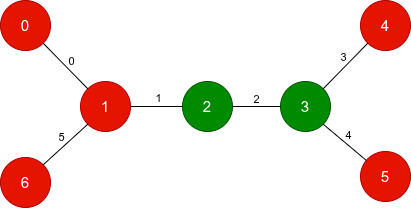
Input: n = 7, edges = [[0,1],[1,2],[2,3],[3,4],[3,5],[1,6]], start = “0011000”, target = “0010001”
Output: [1,2,5]
Explanation:
- Toggle edge with index 1, which flips nodes 1 and 2.
- Toggle edge with index 2, which flips nodes 2 and 3.
- Toggle edge with index 5, which flips nodes 1 and 6.
After these operations, the resulting string becomes "0010001", which matches the target.
Example 3:

Input: n = 2, edges = [[0,1]], start = “00”, target = “01”
Output: [-1]
Explanation:
There is no sequence of edge toggles that transforms "00" into "01". Therefore, we return [-1].
Constraints:
2 <= n == start.length == target.length <= 105edges.length == n - 1edges[i] = [ai, bi]0 <= ai, bi < nstart[i]is either'0'or'1'.target[i]is either'0'or'1'.- The input is generated such that
edgesrepresents a valid tree.
Solution
import java.util.ArrayList;
import java.util.Collections;
import java.util.List;

public class Solution {
    private boolean[] visited;
    private List<int[]>[] adjList;
    private int[] flips;
    private List<Integer> ans;
    private String s;
    private String t;

    @SuppressWarnings("unchecked")
    public List<Integer> minimumFlips(int n, int[][] edges, String start, String target) {
        s = start;
        t = target;
        flips = new int[n];
        adjList = new List[n];
        for (int i = 0; i < n; i++) {
            adjList[i] = new ArrayList<>();
        }
        for (int i = 0; i < edges.length; i++) {
            int[] edge = edges[i];
            adjList[edge[0]].add(new int[] {edge[1], i});
            adjList[edge[1]].add(new int[] {edge[0], i});
        }
        ans = new ArrayList<>();
        visited = new boolean[n];
        dfs(0, -1, -1);
        // Sort indices as required
        Collections.sort(ans);
        // If root is still mismatched, it's impossible (no parent to flip)
        if (mismatch(0)) {
            ans = new ArrayList<>();
            ans.add(-1);
        }
        return ans;
    }

    // Helper to check if current state matches target
    // Logic: If flips is even, bit is original. If flips is odd, bit is inverted.
    private boolean mismatch(int u) {
        return ((flips[u] % 2 == 0) && s.charAt(u) != t.charAt(u))
                || ((flips[u] % 2 == 1) && s.charAt(u) == t.charAt(u));
    }

    private void dfs(int u, int parent, int index) {
        visited[u] = true;
        for (int[] v : adjList[u]) {
            if (!visited[v[0]]) {
                dfs(v[0], u, v[1]);
            }
        }
        if (parent != -1 && (mismatch(u))) {
            ans.add(index);
            flips[u]++;
            flips[parent]++;
        }
    }
}