LeetCode-in-Java


2536. Increment Submatrices by One
Medium
You are given a positive integer n, indicating that we initially have an n x n 0-indexed integer matrix mat filled with zeroes.
You are also given a 2D integer array query. For each query[i] = [row1i, col1i, row2i, col2i], you should do the following operation:
- Add
1to every element in the submatrix with the top left corner(row1i, col1i)and the bottom right corner(row2i, col2i). That is, add1tomat[x][y]for allrow1i <= x <= row2iandcol1i <= y <= col2i.
Return the matrix mat after performing every query.
Example 1:
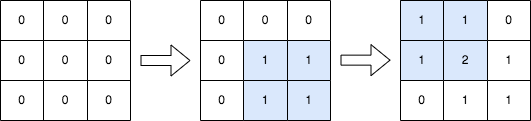
Input: n = 3, queries = [[1,1,2,2],[0,0,1,1]]
Output: [[1,1,0],[1,2,1],[0,1,1]]
Explanation: The diagram above shows the initial matrix, the matrix after the first query, and the matrix after the second query.
-
In the first query, we add 1 to every element in the submatrix with the top left corner (1, 1) and bottom right corner (2, 2).
-
In the second query, we add 1 to every element in the submatrix with the top left corner (0, 0) and bottom right corner (1, 1).
Example 2:
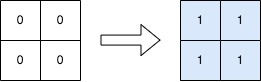
Input: n = 2, queries = [[0,0,1,1]]
Output: [[1,1],[1,1]]
Explanation: The diagram above shows the initial matrix and the matrix after the first query.
- In the first query we add 1 to every element in the matrix.
Constraints:
1 <= n <= 5001 <= queries.length <= 1040 <= row1i <= row2i < n0 <= col1i <= col2i < n
Solution
public class Solution {
    public int[][] rangeAddQueries(int n, int[][] queries) {
        int[][] g = new int[n][n];
        for (int[] q : queries) {
            int r1 = q[0];
            int c1 = q[1];
            int r2 = q[2];
            int c2 = q[3];
            g[r1][c1]++;
            if (c2 < n - 1) {
                g[r1][c2 + 1]--;
            }
            if (r2 < n - 1) {
                g[r2 + 1][c1]--;
            }
            if (c2 < n - 1 && r2 < n - 1) {
                g[r2 + 1][c2 + 1]++;
            }
        }
        for (int i = 0; i < n; i++) {
            for (int j = 0; j < n; j++) {
                if (i > 0) {
                    g[i][j] += g[i - 1][j];
                }
                if (j > 0) {
                    g[i][j] += g[i][j - 1];
                }
                if (i > 0 && j > 0) {
                    g[i][j] -= g[i - 1][j - 1];
                }
            }
        }
        return g;
    }
}